
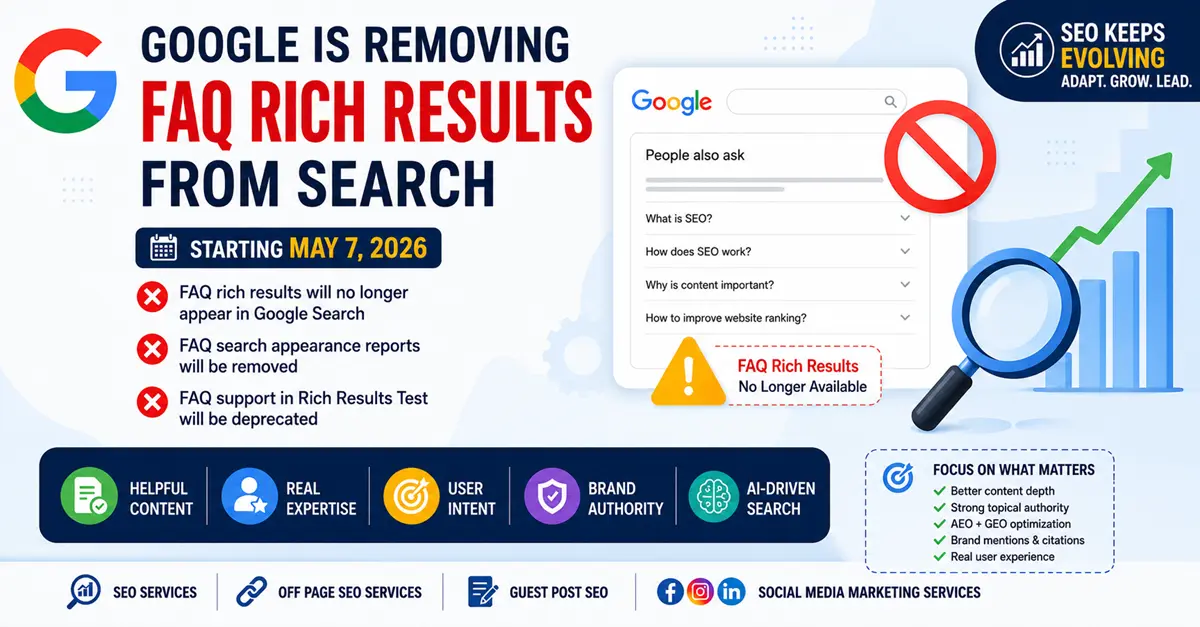
Google has officially confirmed a major change that will impact websites, publishers, bloggers, agencies, and SEO professionals worldwide. Starting May 7, 2026, Google will completely remove FAQ rich results from Search. This update also includes the removal of FAQ search appearance reports and FAQ support inside the Rich Results Test tool.
For years, FAQ schema markup was one of the most commonly used SEO techniques to increase visibility in search results. Many websites relied on FAQ rich snippets to occupy more SERP space, improve click-through rates, and gain a competitive advantage.
Now, Google is shifting its focus toward more helpful, experience-driven, and AI-powered search experiences.
According to SEO Expert Prithwiraj, this update is another clear sign that modern SEO is evolving rapidly. Search engines are no longer rewarding shortcut-based optimization tactics alone. Instead, Google is prioritizing authority, relevance, expertise, and real user value.
What Exactly Is Changing?
Google announced the following changes effective May 7, 2026:
- FAQ rich results will no longer appear in Google Search
- FAQ appearance reports inside Google Search Console will be removed
- FAQ support in Rich Results Test will be deprecated
- Websites using FAQ schema will no longer receive enhanced FAQ snippets in SERPs
This means websites can still technically use FAQ structured data if they want for internal purposes, but it will no longer generate special FAQ search results in Google Search.
Why Google Removed FAQ Rich Results
Over the past few years, FAQ schema became heavily overused across the internet.
Many websites started adding massive FAQ sections simply to gain extra search visibility rather than genuinely helping users. As a result, SERPs became cluttered with repetitive and low-value FAQ content.
Google’s new direction focuses on:
- Helpful content
- Real expertise
- Authentic user experience
- AI-generated search summaries
- Trusted brand signals
- Topical authority
- High-quality information
This aligns with Google’s continued Helpful Content System updates and AI search evolution.
The End of “SERP Tricks” SEO
For many years, SEO strategies focused heavily on manipulating search appearance using:
- FAQ schema
- Excessive structured data
- Clickbait titles
- Thin content
- Over-optimized keywords
- Low-quality backlink schemes
However, modern SEO is becoming more intelligent.
Google’s AI systems now understand:
- Content quality
- User intent
- Brand trust
- Contextual relevance
- Experience signals
- Author expertise
- Engagement behavior
According to SEO Expert Prithwiraj, businesses that continue relying only on outdated SEO tricks will struggle to maintain long-term rankings.
What SEO Professionals Should Focus on Now
The removal of FAQ rich results does not mean SEO is dead. In reality, it means SEO is becoming more strategic and content-focused.
1. Build Strong Topical Authority
Google now rewards websites that deeply cover a topic instead of publishing shallow articles.
Instead of writing:
- “What is SEO?”
You should create:
- Advanced SEO guides
- Case studies
- Technical SEO tutorials
- Content clusters
- Industry trend analysis
- AI SEO strategy articles
Strong topical authority improves:
- Trust
- Crawl efficiency
- Semantic relevance
- AI visibility
2. Focus on Helpful Content
Helpful content is now one of the strongest ranking factors.
Content should:
- Solve real problems
- Answer genuine questions
- Be easy to understand
- Include expert insights
- Offer practical value
- Demonstrate first-hand experience
Google wants content created for humans, not just search engines.
3. Invest in AEO (Answer Engine Optimization)
AI-driven search experiences are growing rapidly.
Platforms like:
- Google AI Overviews
- ChatGPT
- Perplexity AI
- Gemini
- Claude
are changing how users consume information.
AEO helps content become discoverable inside AI-generated answers.
To improve AEO:
- Write concise answers
- Use clear structure
- Add statistics and sources
- Build authority
- Create entity-based content
- Improve semantic optimization
4. GEO Optimization Is Becoming Essential
Generative Engine Optimization (GEO) is the next evolution of SEO.
GEO focuses on optimizing content for AI-driven search engines and generative experiences.
This includes:
- Entity optimization
- Brand mentions
- Contextual authority
- Knowledge graph relevance
- Trust signals
- Structured expertise
SEO Expert Prithwiraj believes GEO will become one of the most important digital marketing strategies over the next few years.
5. Strengthen Off-Page SEO Services
Off-page SEO services are becoming more valuable than ever.
Google increasingly evaluates:
- Brand credibility
- External mentions
- High-authority backlinks
- Digital PR signals
- Online reputation
Modern off-page SEO services should focus on:
- Authority backlinks
- Editorial mentions
- Niche citations
- Digital PR campaigns
- Contextual outreach
- Relationship building
Low-quality backlink spam no longer works effectively.
Guest Post SEO Still Matters — But Quality Wins
Guest posting remains one of the strongest SEO techniques when done correctly.
However, success now depends on:
- Relevant websites
- Real audience engagement
- Editorial quality
- Industry authority
- Natural link placement
Guest post SEO should focus on:
- Thought leadership
- Brand visibility
- Expertise demonstration
- Referral traffic
- Trust building
Spammy guest posting networks can now harm rankings instead of improving them.
Social Media Marketing Services and SEO Are Now Connected
Social media marketing services now play a bigger role in SEO visibility.
While social signals may not directly impact rankings, strong social presence improves:
- Brand awareness
- Content distribution
- User engagement
- Traffic generation
- Brand searches
- Authority perception
Businesses should integrate:
- SEO services
- Social media marketing services
- Content marketing
- Digital PR
- Video marketing
into one unified growth strategy.
AI Is Changing Search Behavior
Search behavior itself is evolving.
Users increasingly expect:
- Instant answers
- Personalized recommendations
- Conversational search
- AI-generated summaries
- Trusted expert content
This means websites must now optimize for:
- Humans
- Search engines
- AI systems simultaneously
The future of SEO is no longer just ranking #1 on Google.
It’s about:
- Becoming a trusted brand
- Being cited by AI systems
- Earning mentions across platforms
- Building authority everywhere online
What Businesses Should Do Right Now
To stay competitive after Google removes FAQ rich results, businesses should:
Improve Content Depth
Create comprehensive and authoritative content instead of thin articles.
Build Real Expertise
Showcase expert insights, real experiences, and trustworthy information.
Invest in SEO Services
Professional SEO services can help businesses adapt to AI-driven search changes.
Focus on Off-Page SEO Services
Authority backlinks and digital PR remain critical ranking factors.
Use Guest Post SEO Strategically
Publish high-quality content on reputable websites in your niche.
Expand Social Media Marketing Services
Build audience trust and improve brand visibility across platforms.
Optimize for AEO + GEO
Prepare content for AI-driven search experiences.
Final Thoughts
Google removing FAQ rich results marks another major shift in the SEO industry.
This update proves that modern SEO is no longer about exploiting SERP features alone. Success now depends on:
- Helpful content
- Real expertise
- Brand authority
- User trust
- AI optimization
- High-quality SEO services
- Strategic off-page SEO services
- Smart guest post SEO
- Strong social media marketing services
According to SEO Expert Prithwiraj, the future belongs to businesses and creators who adapt quickly, build genuine authority, and prioritize long-term value over short-term SEO tricks.
As AI-powered search continues to evolve, brands that invest in trust, relevance, and expertise will dominate the next generation of search results.